Org Launcher A Mac app for switching between Salesforce orgs
Open any org in your browser in one click. Query your data and export it to Excel, load records back in from a spreadsheet, and see what changed in Setup. No command line.
Beta 1.1.7 · 9.0 MB · macOS 14 or later · Apple Silicon and Intel
This is a beta, so macOS asks you to approve it once. How to install
Org Launcher Pro — optional upgrade
Coming this weekend: Org Launcher for Windows
It reads the Salesforce orgs you have already signed in to with the Salesforce CLI on that PC, so they are in the list the first time you open it. Not everything on this page is in the first Windows version — see what is included, or ask us to send you the link when it is ready.
A Mac app for Salesforce admins, developers, and consultants. A Windows version arrives this weekend.
What it does
Get into an org
Launch in one click
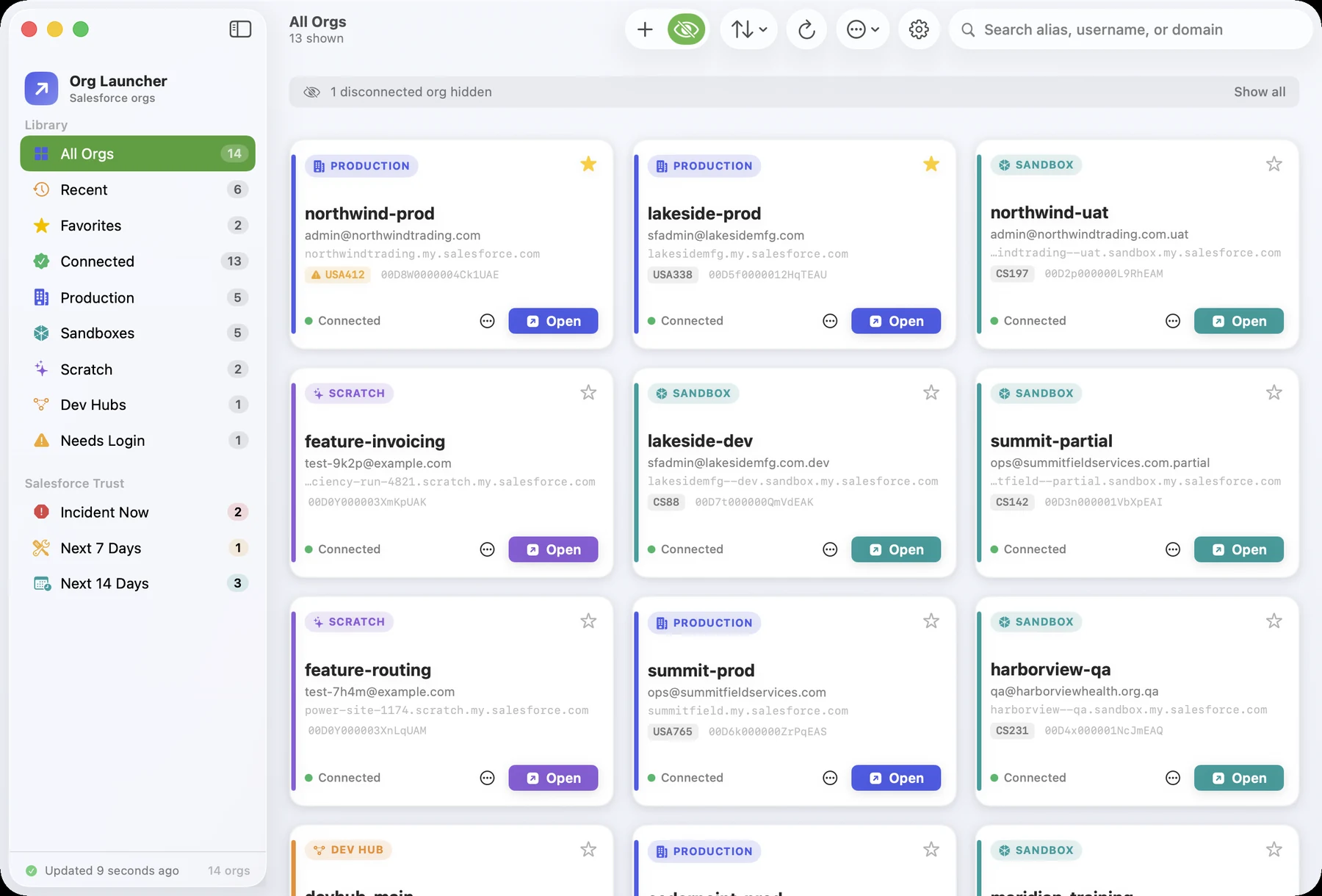
Every Salesforce org you have authorized with the CLI, in one searchable list. Click Open and you are logged in, no password and no Terminal.
Open from Spotlight
Your orgs appear in Spotlight. Press Command-Space, type the alias, and the org opens logged in without switching to the app first.
Ready the moment you open it
Your org list is saved on your Mac, so nothing waits on a network call. Connections are re-checked in the background.
Adding and reconnecting do not make you wait
Log in once in your browser and the org appears on its own. If you would rather not wait, press I've finished signing in and it looks straight away. A login that has expired is the same: the app asks about that one org rather than re-checking every org you have, so it comes back just as quickly whether you keep three orgs or thirty.
Query and export your data
Build a query by clicking
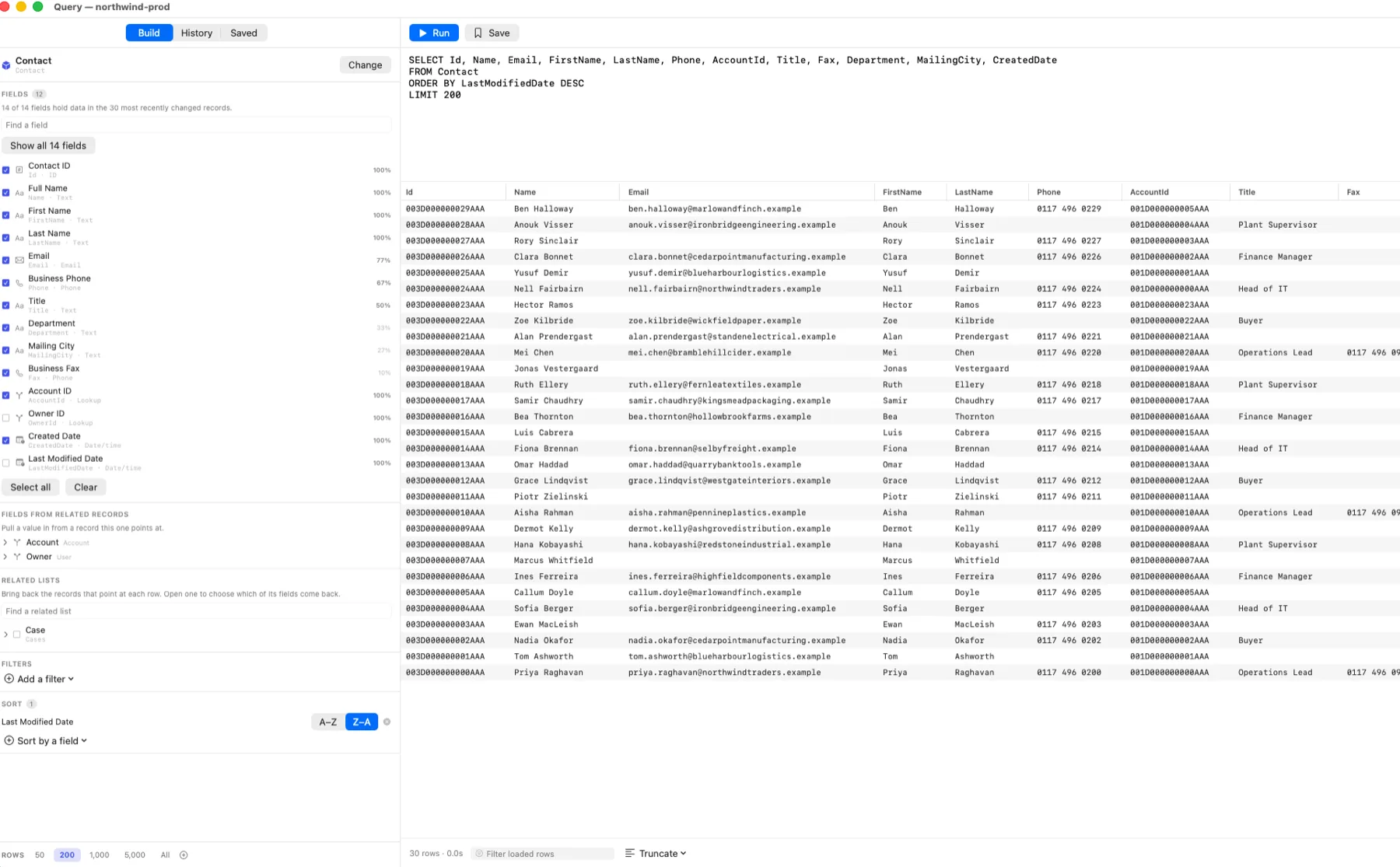
Pick an object and the query is written for you. Tick fields to add or remove them, add filters from plain choices like “is after” and “contains”, choose the sort, and set how many rows with one button. You never have to type SOQL.
It knows which fields your org uses
Choosing an object looks at your recent records and shows how often each field is actually filled in. An object with 217 fields opens with the 14 your org uses rather than all of them, and every field shows a percentage so you can see what is really there.
The objects you use, first
The picker leads with the objects you query most, then with the ones holding the most records — so Account and Contact are at the top instead of buried alphabetically among seventeen hundred names.
Related records and related lists
Pull a value in from a record yours points at, like an account name on a contact. Bring back the records that point at yours, choosing which of their fields come with them.
The SOQL is always there
Read it, copy it, send it to a colleague, or edit it by hand. Edit it into something the builder has no controls for and it tells you, and leaves your query exactly as you wrote it rather than rewriting it.
Write SOQL with help
Type-ahead suggests objects, fields and related records as you go, and shows each field label and type next to the API name — so you can find Billing State/Province without knowing it is called BillingState. Typing a picklist value offers the values that field accepts, already in quotes — the value Salesforce stores is often not the label you see on the page, and an unquoted one is a query that will not run.
Results you can actually read
Drag any column heading to resize it, or switch the whole table between cutting long values off, wrapping them, and widening every column to fit what is in it.
Straight into a spreadsheet
Copy pastes into Excel or Google Sheets as columns, and you can export to CSV or a real Excel file. Date and number columns arrive as real dates and numbers, so you can filter a date column by month, sort it in date order, and add a column of numbers up. Record ids, phone numbers and anything with a leading zero stay exactly as they are.
Extracts of any size
No row limit. Rows appear as they arrive, a Stop button ends a long pull and keeps everything already loaded, and a filter box searches what you have without going back to Salesforce.
Keep the queries that work
Every query you run is kept in History, and the ones worth keeping can be saved by name and re-run against any org.
Change data from a spreadsheet
Insert, update, upsert, delete
Paste rows straight out of Excel or Google Sheets, or drop a CSV or Excel file. Columns are matched to fields by API name or label, and when two fields could both be meant, it asks instead of guessing.
Your spreadsheet, not Salesforce's format
8/3/26, $1,250.00, Yes, 50% and (350) all become what the API expects. Excel dates stay dates instead of arriving as five digit numbers. Long external keys keep every digit.
Fill lookups with your own keys
A lookup or master-detail field can take an External ID value from whatever system the data came out of, instead of a Salesforce record ID. When the target has one External ID field it is picked up for you.
Related records in one file
An Excel file can hold a tab per object. Parents are created before children, rows link by a nickname, and a template for several objects arrives already wired together.
Fix mistakes before they land
Rows that would be rejected show in red with the reason, before anything is sent. Click any value to correct it in place — no going back to Excel and pasting again.
A way back from every error
Updates back up current values to a CSV first, deletes save a receipt, and an insert can be undone in one click. Failed rows export with the reason, and you can return to fix them with everything still set up.
Find and merge duplicates
Any object, your rules
Pick the records to check and the fields that decide a duplicate. Exact ignores capitals, spacing and endings like Inc or LLC. Close catches typos like Jon and John, short forms like Ed for Edward, and a phone number written five different ways.
Duplicates inside one account
Match on a lookup as well as a name, so you find the two Meredith Mannings sitting under the same account and not the ones at different companies. A filter can narrow the check before anything downloads.
Two million records, on your Mac
Records are copied down and compared here, so nothing you try can change Salesforce. Two million of them compare in about fifteen seconds, and the screen shows what it is using and what is free before it starts.
See who has the history
Count the tasks, cases and opportunities behind every record in every group, and open any list to read them. The record carrying the history is usually the one to keep — and it is easy to keep the wrong one without looking.
A real merge, not a delete
Salesforce's own merge moves everything attached to the duplicates onto the record you keep, one at a time to stay clear of limits. Choose which values the survivor ends up with first, field by field.
Hand the list to your client
Every group exports to Excel with the fields you chose, and with the related record counts too once you have counted them. They mark Keep, Delete or Not a duplicate, you load the file back, and the deletions they marked are what gets carried out — nothing else, and nothing you have not seen.
A review can take days
Mark records that are not duplicates and they stop being suggested, remembered between sessions. Search the results, work through one group at a time, and every record is re-checked against Salesforce before anything changes.
Match on a field from a linked record
Check contacts for duplicates using the account name they sit under, without first building a formula field to copy it onto the contact. Any lookup on the record can be opened to reveal its fields. It also tells you how many records have no linked record at all, because those are never counted as duplicates.
Compare two kinds of record against each other
Salesforce's own duplicate rules pair up the objects it knows about. Org Launcher compares any two or more kinds you choose — the same person sitting in your leads and in your contacts, the same company in two custom objects. You write a rule such as “last name” and say which field answers it on each kind, so it does not matter that the fields have different names. Each kind's fields are listed on screen with a box to search them by name, so finding one on a wide object does not mean scrolling. Merging is not possible between different kinds, so it is not offered; you can look, export, and delete the extras. Leads you have already converted are left out unless you ask for them — a converted lead is the contact it became, so counting those as duplicates would bury the real ones under every conversion your org has ever done.
Catches +tag email addresses
People add a tag to an address so one mailbox looks like many — ejbantz+test@gmail.com is delivered to ejbantz@gmail.com and is the same person. Org Launcher groups them, in exact matching as well as close. The address is never rewritten on the record, and a pair matched this way is never reported as identical — so a shared inbox like info+sales@ and info+support@ is always flagged as a group holding records that do not really look alike.
Ignores values that do not name anybody
A blank field never counts as a match, and neither should a field that says “unknown” or “not provided”. On one real org those two values covered 14 percent of leads — forty times more than the most common real surname — and every one of them agreed with every other. Org Launcher treats them as missing, shows you every value it found with a count, and puts any of them back with one click.
Breaks up groups that are not all alike
Sometimes each record is close to the next one but the two ends are nothing alike, and hundreds of different records end up in one group. Org Launcher spots that, checks the group again, and splits it into smaller groups whose records really do match each other. A group where every record already agrees is never broken up, however large. No record is dropped.
Hold back what is too big to be sure about
Set a number. A group holding more different-looking records than that still shows up, marked, but tagging, filling, merging and deleting skip it until you have looked at it yourself. Records that are exactly the same count as one, so a pile of identical rows is never held back.
Reuse the setup from any earlier run
The fields that decide a duplicate are remembered for each object, so running again next month does not mean ticking twenty boxes again. Pick any earlier setup by what it matched on and when you last used it, change anything you like, and run.
Know what is happening
Storage and API limits
See data storage, file storage and daily API usage for any org. Cards warn you at 80 percent, an At Risk group collects every org that is close, and orgs past their allowance say how far over they are.
Know your release date
Every card shows the next Salesforce release and the day it reaches that org. Salesforce upgrades instances in waves, so two orgs on the same release can be a month apart.
Outages at a glance
Instance badges turn amber or red when Salesforce reports an incident, with maintenance and release windows a click away.
Who changed what in Setup
Read an org Setup Audit Trail without logging in. Filter by person, period or text, and export it to CSV. Automated entries are hidden so real changes stand out.
Release updates before they bite
Salesforce switches some changes on for you, on a deadline, whether or not anyone acts. See which ones are still outstanding in any org, how many days past due each one is, and what it actually does. An Updates Past Due group collects every org with one already overdue.
Work one update across every org
See a single release update with the list of orgs where it is still outstanding, so you can do the work once and tick each client off. Salesforce Setup cannot answer this — it only ever shows one org at a time. Export the whole thing as one row per org.
Check your sending domains are proven
Salesforce needs each org to prove it owns the domain it sends from — with either an active DKIM key or a verified authorized email domain, whichever you prefer. See which orgs have one, which have neither, and what happens if nobody acts, across every org rather than one Setup page at a time.
Confirm the DNS behind it
Salesforce can tell you it considers a domain verified. It cannot tell you the DNS record behind it is still published. Optionally look up the DKIM, SPF and DMARC records yourself for every sending domain, see the actual values as they stand today next to what needs changing, and export the lot to Excel to hand to the client. A lookup that fails is reported as “could not check”, never as a fault.
Sort the urgent from the noise
Most of the list is informational or already done. Only what genuinely needs action is counted, so a real deadline is not buried under sixty items nobody has to touch. Filter by category, search the text, and export the list to Excel or CSV for a client.
Track metadata changes
See what changed
Scan an org for recently changed metadata. Filter by the person who changed it, a date range, or a name search.
Compare two orgs
Pull the same components from two orgs and see, file by file, exactly what is different.
Extract to Downloads
Save any selection of components as source files, ready to review or move to another org.
Jump to the component
Go straight from a change in the list to that component inside Salesforce.
Keep your org list clean
Catch expiring scratch orgs
Scratch orgs and trials show how long they have left, turning amber inside a week and red once they are gone, so a dead org never looks like a working one.
Clear out stale logins
Remove the logins that no longer work, in bulk. You review the full list first, keep any you want, and confirm by typing the count. Nothing in Salesforce is deleted.
Build a query by clicking
Pick an object and the query is written for you. The percentages down the side are how often this org actually fills each field in, worked out from its own recent records — so you start with the fields your data really uses instead of all 217 of them. Add filters, sorting and related records the same way. The SOQL is always there to read, copy or edit.
Load a spreadsheet into Salesforce
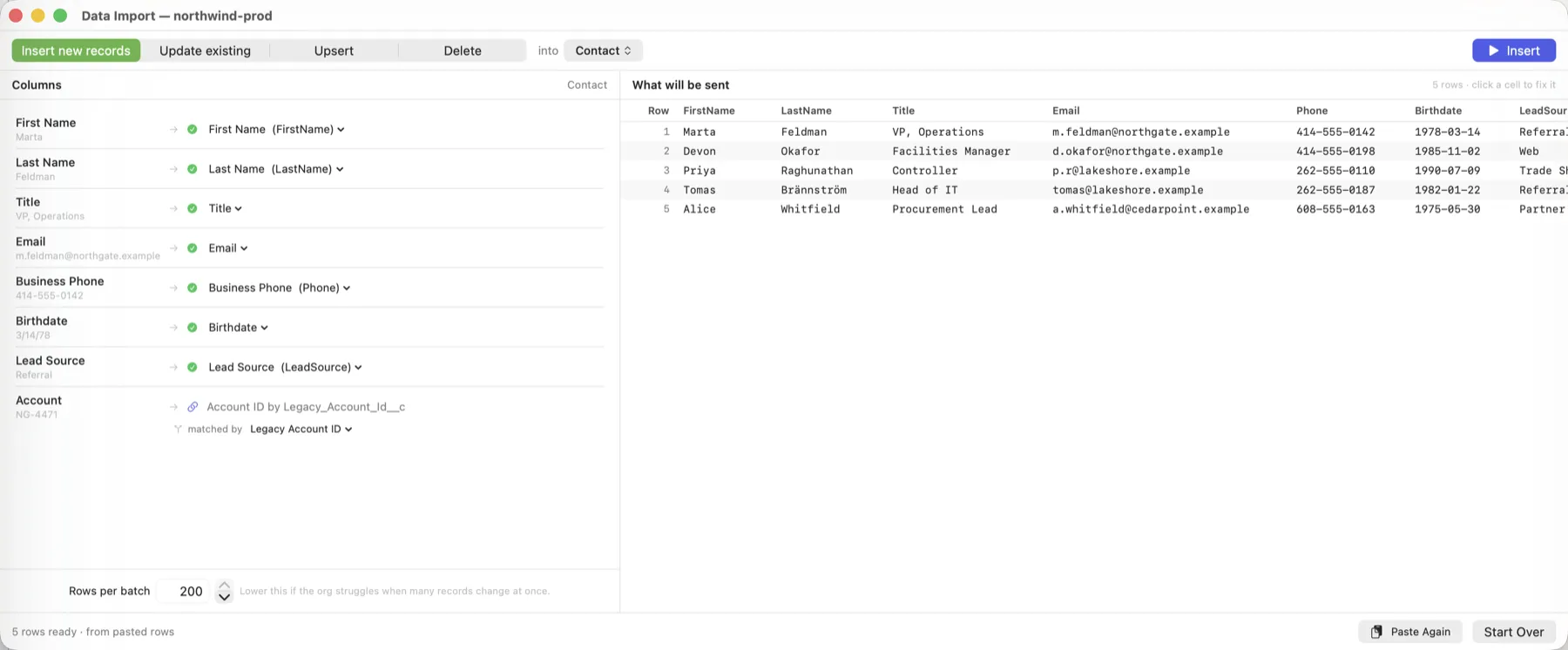
Paste your rows and the columns are matched to fields, the values are converted to what Salesforce expects, and you see exactly what will be sent before anything is. Here a birthdate typed as 3/14/78 is on its way as 1978-03-14, and the Account column holds a key from the old system rather than a Salesforce ID.
Find duplicates without changing anything
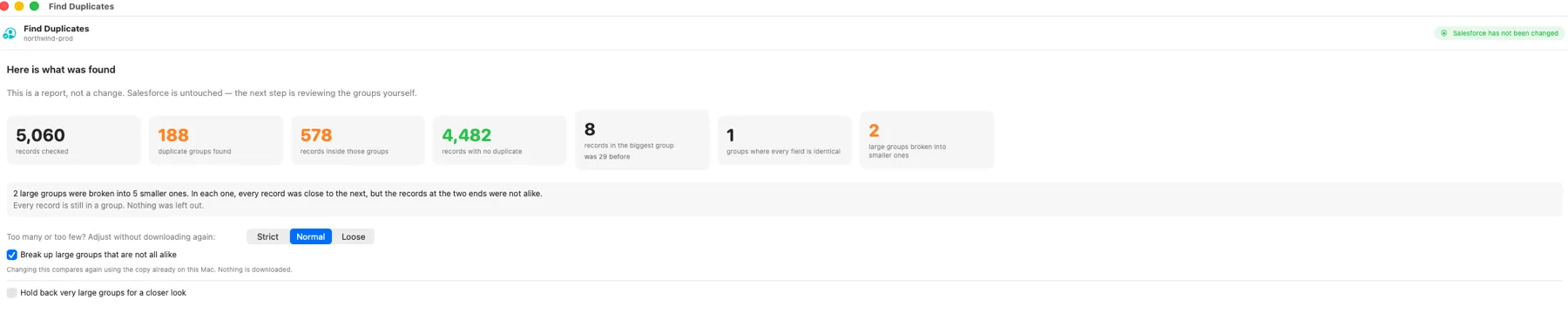
Finding them is a report, not a change. You get a count of what matched, how big the biggest group is, and how many records were left alone — and Salesforce is untouched until you say otherwise. If the matching is too keen or too shy, adjust it and it compares again using the copy already on your Mac, without downloading anything a second time.
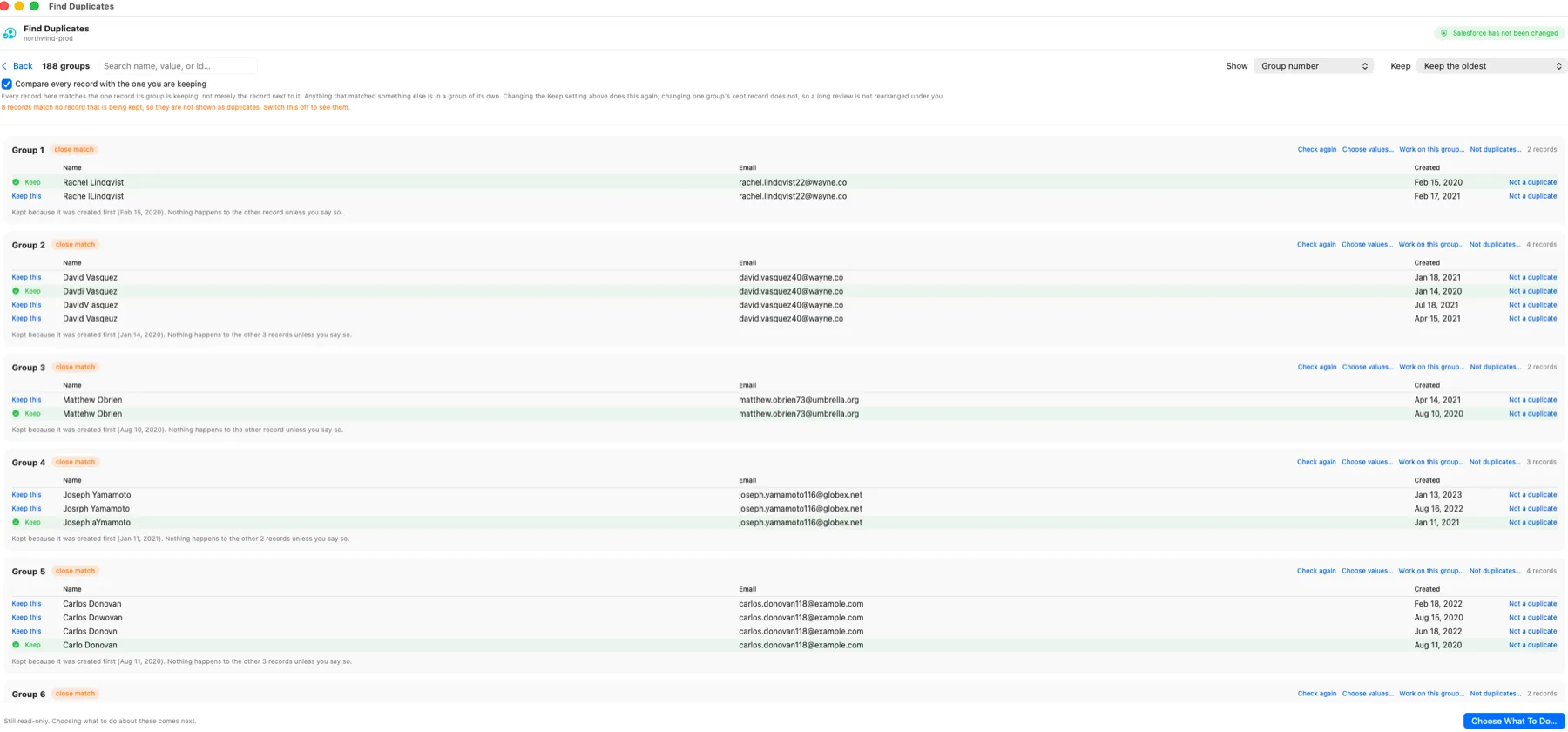
See every group before you decide
Every group is laid out with the record being kept, why it was kept, and a line saying nothing happens to the others unless you say so. Typos, transposed letters and a missing character are all found — matching is not just exact matches. Mark anything that is not really a duplicate and it drops out.
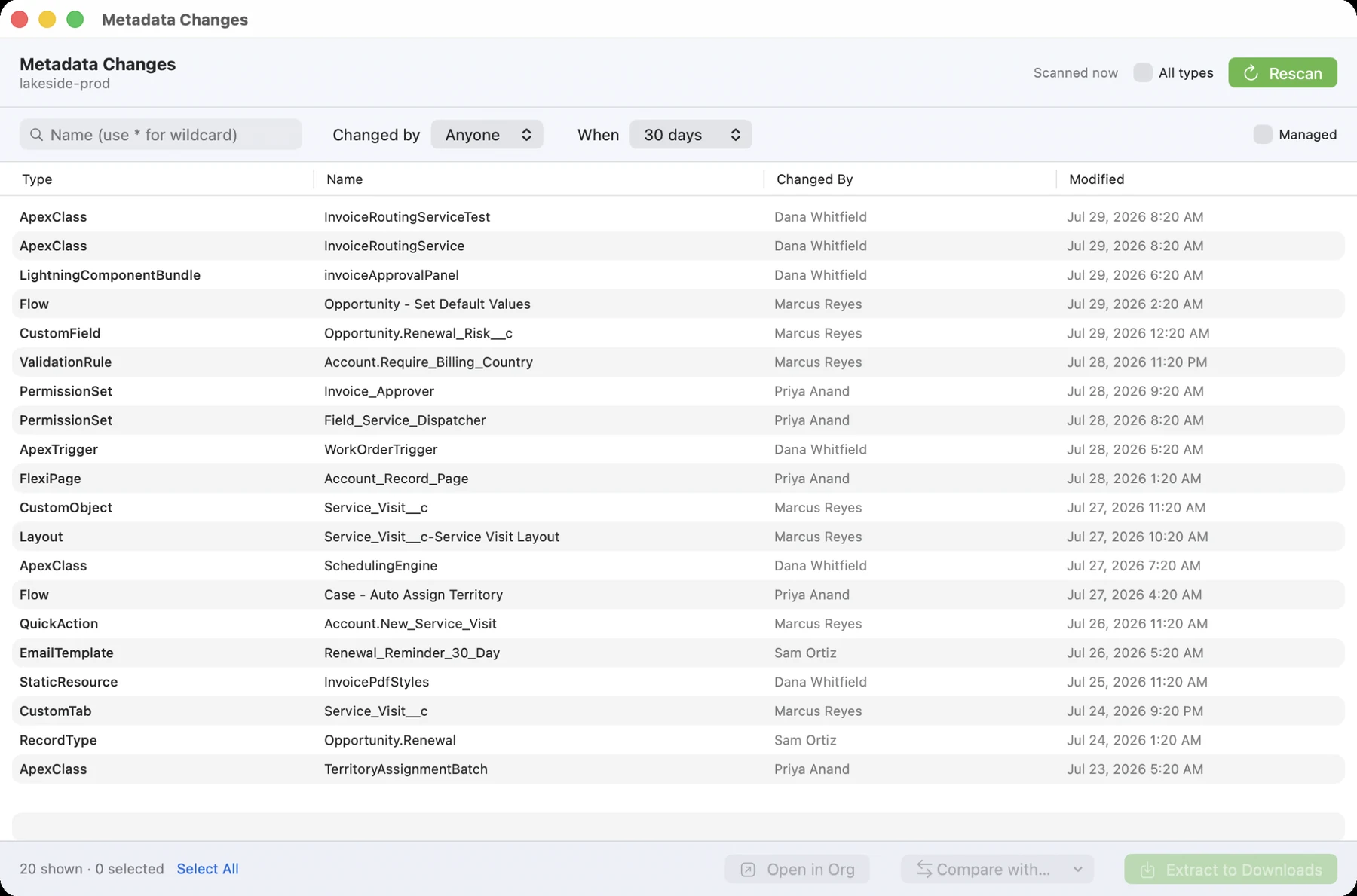
Find what changed, and who changed it
Scan an org for recent metadata changes, then narrow the list by person, date range, or a wildcard name search. Extract what you find, or compare it against another org.
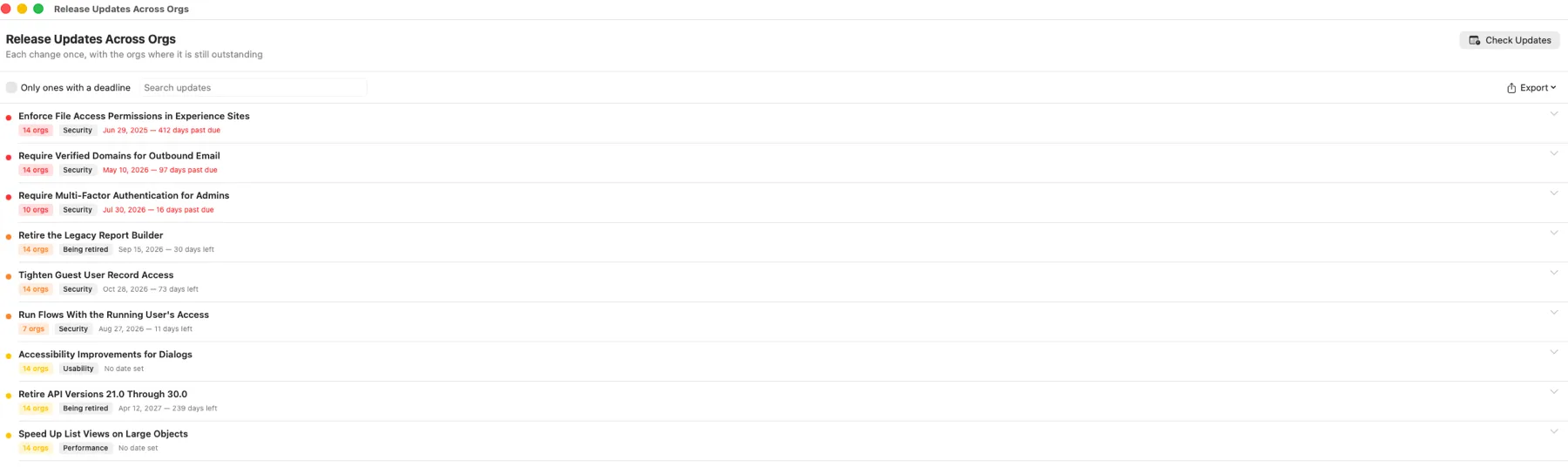
Every Release Update, and every org still waiting
Salesforce shows Release Updates one org at a time, so the same change has to be chased separately in each. This is the other way round: each change once, with the orgs where it is still outstanding and how long it has been overdue. Sort out the ones in red first.
Org Launcher for Windows
A Windows version arrives this weekend, and it is free like the Mac one. It works the same way: it reads the Salesforce orgs you have already signed in to with the Salesforce CLI on that PC, so they are in the list the first time you open it.
What is in the first Windows version
- Opening any authorized org in your browser, already logged in, with search, filters and favorites
- The query builder, SOQL type-ahead, saved queries and history, and export to Excel or CSV
- Loading a spreadsheet into Salesforce — insert, update, upsert and delete, with a backup taken first and failed rows retried on their own
- Storage and API limits, Salesforce Trust status and incidents, and the next release date
- The Setup Audit Trail, with filters and CSV export
- Release Updates, both for one org and across every org at once
- Email domains and their DKIM keys
What is not in it yet
Finding and merging duplicate records is not in the first Windows version. Neither is tracking metadata changes or comparing two orgs side by side. A few smaller things are Mac only as well — opening an org from Spotlight, for instance, has no Windows equivalent. All of it is being worked on, and the list above is what the first Windows version does today.
What you need
- Windows 10 version 1809 or later, 64-bit
- The free Salesforce CLI, the same one the Mac version uses
Like the Mac beta, the Windows build is not signed yet, so Windows will warn you the first time you run it. Installing does not need an administrator, and nothing else has to be installed first.
Leave your details and we will send you the link as soon as it is ready.
Installing the beta on a Mac
This is a pre-release build, so macOS asks you to approve it the first time. That is expected and takes about 30 seconds. You only do it once.
- Open the download and drag Org Launcher to your Applications folder.
-
Open Applications and double-click Org Launcher.
macOS shows a message saying it cannot verify the developer, with only a Done button. That is normal for a beta. Click Done. -
Go to System Settings > Privacy & Security.
Scroll down to the Security section. You will see “Org Launcher was blocked to protect your Mac.” Click Open Anyway and confirm with Touch ID or your password. - Org Launcher opens. After this first approval it opens normally, like any other app.
On macOS 15 and later, right-clicking the app and choosing Open no longer works. Use the System Settings steps above.
Once the final release is signed by Apple, it will install with no approval step at all.
What you need
- A Mac running macOS 14 (Sonoma) or later. Apple Silicon and Intel are both supported. A Windows version arrives this weekend.
- The free Salesforce CLI. Org Launcher tells you if it is missing and links you to the installer.
Getting started
- Drag Org Launcher to your Applications folder and open it.
- Your orgs appear automatically. If the list is empty, click the + button to connect one.
- Click Open on any org to launch it in your browser.
- Right-click an org for more: open Setup, copy a login link, review recent changes, or compare it with another org.
Your credentials stay on your Mac
Org Launcher never stores your Salesforce passwords or access tokens. It uses the connections you have already authorized with the Salesforce CLI, and everything it reads stays on your computer. The only thing it sends us is +1 to the launch counter below — no identifier, no account, no IP address logged — and you can switch that off in Settings. Read the privacy policy.
Tell me when it is ready
The Mac beta above works today. Leave your details and we will tell you when the Windows version is ready to download, and when the final Mac release is signed so it installs with no approval step.
We only use your details to tell you about Org Launcher. No newsletters, and we never share them.
Common questions
Is there a Windows version of Org Launcher?
Yes, and it arrives this weekend. It is free like the Mac version, and it reads the Salesforce orgs you have already signed in to with the Salesforce CLI on that PC, so they are in the list the first time you open it. The first Windows version opens your orgs, builds and runs queries and exports them, loads a spreadsheet back into Salesforce, and covers storage and API limits, Trust status, the Setup Audit Trail, Release Updates and email domains. Finding and merging duplicates is not in it yet, and neither is tracking metadata changes or comparing two orgs. Those are being worked on. Leave your details in the form on this page and we will send you the link.
What do I need to run Org Launcher on Windows?
Windows 10 version 1809 or later, 64-bit, and the free Salesforce CLI — the same one the Mac version uses. Nothing else has to be installed first, and you do not need an administrator to install it. Like the Mac beta, it is not signed yet, so Windows will warn you the first time you run it.
Can it check whether our email domains are set up correctly?
Yes, in two halves. It reads the authorized email domains and DKIM keys from each org and shows which ones Salesforce has actually verified. It can then look up the DNS records behind them — DKIM, SPF and DMARC — and tell you whether they really are published, which is the part Salesforce cannot see. A domain can show as verified in Salesforce long after somebody removed the DNS record. Those DNS lookups are switched off until you turn them on, because they are the only requests the app makes that do not go to Salesforce. A lookup that does not answer is reported as “could not check” rather than as a problem.
What are Salesforce Release Updates, and why does this matter?
Salesforce sometimes changes how something works and gives you a deadline to get ready. After that date it switches the change on for you whether or not anyone has acted. They are listed in Setup, one org at a time, which is why they are easy to miss. Org Launcher reads that list for any org and shows what is still outstanding, how far past due it is, and what the change actually does. It never activates one — that stays in Salesforce Setup, because activating a release update can change how an org behaves.
How do I see how much storage a Salesforce org is using?
Right-click the org in Org Launcher and choose Storage & Limits. It reads data storage, file storage, daily API calls and every other limit Salesforce reports, and shows how much of each is used. You can also check every connected org at once, and the At Risk group lists any org at 80 percent or more.
When will my Salesforce org get the next release?
Every org card shows the next seasonal release and the date it reaches that org. Salesforce upgrades instances in waves over several weeks, so two orgs on the same release can be a month apart. The sidebar groups your orgs by wave so you can see which ones go first.
How can I see who changed something in Salesforce Setup?
Open the Setup Audit Trail for that org from the right-click menu. It shows who changed what and when, filtered by person, period or text, and exports to CSV. Entries Salesforce logs as Automated Process are hidden by default so real changes are easy to see.
Can I query Salesforce records and export them to Excel?
Yes. Open Query Records on any connected org, build the query by clicking or write SOQL with type-ahead help, and export the results to Excel or CSV. Copy also pastes straight into a spreadsheet as columns. Record ids stay as text rather than being turned into scientific notation, which is what happens when a CSV of ids is opened in Excel.
Can I filter and sort an exported date column in Excel?
Yes. Date, date/time and number columns are written as real dates and numbers, so Excel offers its date filters — this month, last year, between two dates — and sorts them in date order rather than alphabetically. A number column can be added up and sorted properly, so 2 comes before 10 instead of after 1. Record ids, phone numbers and anything with a leading zero are left exactly as they are, because turning those into numbers would damage them.
Does it know my picklist values when I write a query?
Yes. When you are typing the value in a filter, it offers the values that field accepts, already in quotes. This matters because the value Salesforce stores is often not the label you see on the page — a stage shown as “Closed Won” may be stored under a different name — and a picklist value without quotes is a query that will not run.
Can I query Salesforce without knowing SOQL?
Yes. Pick an object and the query is written for you. Tick fields to add or remove them, add filters from plain choices like “is after” or “contains”, choose how to sort, and set how many rows with one button. The query text is always on screen to read, copy or send to a colleague, and you can edit it by hand at any point. If you edit it into something the builder has no controls for, it tells you and leaves your query exactly as you wrote it.
How do I know which Salesforce fields are worth querying?
Choosing an object looks at its most recently changed records and reports how often each field is actually filled in. A field used on 90 percent of records and one used on 2 percent look very different, and the query opens with the ones your org really uses instead of every field on the object. You can still show all of them with one click.
Can I query a related record or a related list?
Yes to both. You can pull a value in from a record yours points at, such as the account name on a contact, without creating a formula field first. You can also bring back the records that point at yours — an account's contacts, for example — and choose which of their fields come with them.
Can it download a large Salesforce table?
Yes, there is no row limit. Rows appear as they arrive rather than after the whole extract finishes, a Stop button ends a long pull and keeps everything already loaded, and a filter box searches the rows you have without querying Salesforce again.
Do I need the Salesforce CLI?
Yes. Org Launcher works with the orgs you have already authorized in the Salesforce CLI (sf). It does not store passwords or tokens of its own — logging in happens in the CLI and your browser, exactly as it does today.
Will it match a lead against the contact it was converted into?
Not unless you ask it to. A converted lead is the same person as the contact it became — Salesforce keeps the lead as history — so Org Launcher leaves converted leads out by default when it compares leads against contacts. Untick “Ignore leads that have already been converted” if you want to see them. With them left in, every conversion your org has ever done comes back as a duplicate, which buries the pairs that are real mistakes under hundreds that are not.
Can I find duplicate records in Salesforce?
Yes. Right-click a connected org and choose Find Duplicates. Pick the object and the fields that decide a duplicate — exact matching ignores capitals, spacing and endings like Inc or LLC, and close matching catches typos like Jon and John, short forms like Ed for Edward, and phone numbers written different ways. The records are copied to your Mac and compared there, so nothing changes in Salesforce while you look.
How do I find duplicate contacts under the same account?
Choose the Account lookup as one of the matching fields, together with first and last name. A lookup only matches when both records point at the same account, so you get the two people duplicated inside one company and not everyone in Salesforce who shares a name. You can also add a filter such as Account.BillingCountry = 'USA' so only the records you care about are checked at all.
Can it merge duplicate Salesforce records, not just delete them?
Yes, for Accounts, Contacts, Leads and Cases it runs Salesforce's own merge, so activities, cases, opportunities and everything else attached to the duplicates move onto the record you keep. Merges run one record at a time to stay clear of limits. Before merging you can compare what each record has attached, and choose field by field which values the surviving record ends up with.
How many records can it check for duplicates?
Two million compare in about fifteen seconds on an Apple Silicon Mac, using around 475 MB of memory. Records download once to a local file, so changing how strict the matching is, or whether oversized groups get broken up, does not download anything again. The app shows what it is storing and how much space is free before the download starts.
Why are some records left out of the duplicate check?
Two reasons, and both are said on screen with counts. A record whose chosen field is empty is left out, because an empty field is not evidence that two records are the same person. A record whose field says “unknown”, “not provided” or something similar is left out for the same reason — it is the same statement typed out. On one real org those values covered 14 percent of leads and were quietly pulling strangers into the same group. Every value found is listed with how many records carry it, and unticking one brings those records straight back, compared again from the copy already on your Mac. You can add values of your own too.
Why did one huge group become several smaller ones?
Because it was not really one group. Matching can run from one record to the next, so a record joins a group without looking like most of the records already in it — each one is close to the one beside it, while the two ends have nothing in common. On one real org that produced a single group of 4,906 leads with unrelated first names. Org Launcher checks a large group again and, when it finds that pattern, breaks it into smaller groups whose records really do match each other. A group where every record already agrees is never broken up, however large it is. You can switch it off and compare again without downloading anything.
Does every record in a group really look like the one being kept?
Yes, and that is the default. Every record shown in a group is compared against the record you are keeping, not merely against whichever record happens to sit next to it. It means a long review does not get rearranged under you when you change your mind about which record to keep. Any record that matched something else but does not match the kept record is set aside rather than shown as a duplicate, and the screen says how many — switch the setting off to see them.
Can my client review the duplicates before anything is deleted?
Yes. Export every group to Excel — the file carries the fields you chose and, when you asked for them, a count of the tasks, cases and opportunities behind each record, with the suggested record to keep highlighted. Your client marks Keep, Delete or Not a duplicate, you load the file back, and only what they marked is carried out. Records marked as not duplicates stop being suggested and are remembered between sessions, so a review can take days.
Is Org Launcher free?
Yes, it is free to download and use. The Mac version runs on macOS 14 or later and works on both Apple Silicon and Intel Macs. A Windows version arrives this weekend and is free too. Org Launcher Pro is an optional upgrade — Founders $49 lifetime or Annual $79.
Can I open a Salesforce org without opening the app first?
Yes. Org Launcher adds your orgs to Spotlight, so pressing Command-Space and typing the alias opens the org logged in. You can switch that off in Settings.
Can I insert or update Salesforce records from a spreadsheet?
Yes. Right-click a connected org and choose Import Data. Paste rows from Excel or Google Sheets, or drop a CSV or Excel file, then insert, update, upsert or delete. Columns are matched to fields by API name or label, values like 8/3/26 and $1,250.00 are converted to what Salesforce expects, and there is no row limit.
Can I set a lookup field using an External ID instead of a Salesforce record ID?
Yes. Any lookup or master-detail column can hold a value of an External ID field on the object it points at, which is what data coming out of another system usually has. When the target object has a single External ID field it is used automatically, and you can change which one under the column's matched by control.
Can I import related records, like accounts and their contacts, in one go?
Yes. Put one tab per object in an Excel file. Parents are created before children, and a row in a child tab points at its parent by a nickname in a Reference column, or by the parent's External ID. You can generate a template covering several objects that arrives already linked.
What happens if an import goes wrong?
Updates save the current values of every field being changed to a CSV in Downloads before anything is written, deletes save a receipt, and an insert can be undone in one click. Rows that fail export with the reason, and you can go back and fix them with the object and column mapping still set up. Rows that already went in are held back so nothing is created twice.
Questions?
Email ejbantz@dewwow.com and include the version number from Org Launcher > About Org Launcher.
Overview · Release notes · Privacy · What it calls
DewWow LLC · Wisconsin’s Odoo Partner · dewwow.com
Salesforce and related marks are trademarks of Salesforce, Inc. Org Launcher is an independent product and is not affiliated with, endorsed by, or sponsored by Salesforce, Inc.